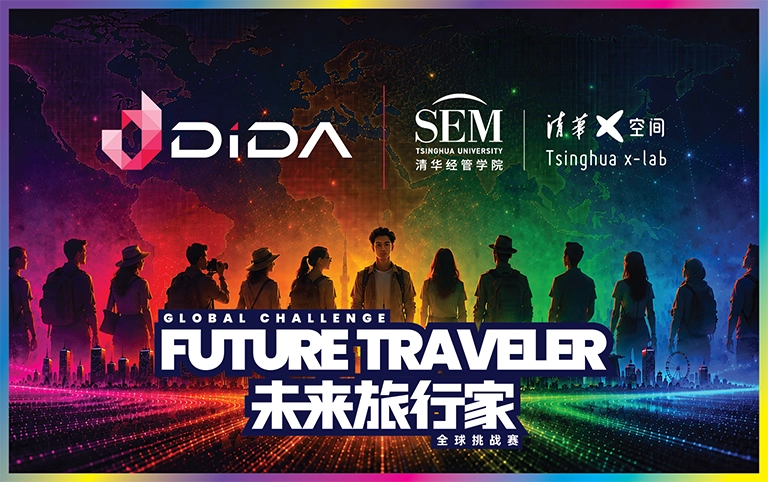

Most student competitions end with a certificate and a group photo. The Future Traveler Global Challenge, launched today by Dida, the AI-first travel technology group, and Tsinghua x-lab, is designed differently. The strongest solutions will be tested inside Dida’s live operations, with the best having a pathway into production.
The challenge is the first global initiative under the five-year strategic partnership signed by Dida and Tsinghua x-lab in April.
The competition is aimed squarely at the gap between prototype and production. A travel agent demo that works beautifully in a lab can fall apart the moment it touches a live booking flow. Under the theme “AI Travel 2030: Travel Innovation in the Age of AI Agents,” student teams will work on operating scenarios drawn directly from Dida’s international business, including problems the company’s own engineers are working on today.
“We have spent the last year building agents into our own booking flows, and the hardest problems are not the ones you can see from outside the industry. Inventory changes while an agent is reasoning about it. Cancellation rules differ by supplier and market. A solution has to work not just in a demo, but across real transactions at scale. We are handing students the same problems our own engineers are working on, and the strongest solutions will have the opportunity to make their way into production.” said Daryl Lee, Group CEO of Dida Holdings.
The competition is open to students from Tsinghua University and participating European universities and is expected to reach more than 50 institutions across Europe. More than 100 teams are expected to register between September 1 and 14, submitting either a project proposal or a demo video.
Thirty teams will advance to the semi-final in Paris on October 28 and 29, with ten progressing to the global final in China in November.
Teams compete in one of two tracks:
Business Innovation Track - Exploring how AI agents will reshape the online travel value chain and the commercial opportunities this creates for distributors, suppliers and platforms.
Technology Track - Building working next-generation travel agent solutions against live booking, servicing and distribution scenarios.
Participants will receive free CPU and GPU resources and rapid deployment support from technology partner Alibaba ModelScope. Ecovacs & PGY Accelerator, which supports early-stage hardware and AI ventures, will provide industry, supply chain and financing resources to help promising solutions move from technical validation towards commercial application.
Selected teams and individuals will also be offered internships at Dida and the opportunity to test their work against live business operations.
“We have always placed great importance on nurturing innovative talent, with a strong focus on developing students who combine an innovative mindset with practical capabilities. Dida Holdings’ global presence and forward-looking exploration in travel technology can provide students with valuable industry resources and real-world opportunities, enabling them to strengthen their innovation capabilities and broaden their overall skills by tackling real industry challenges,” said Professor He Ping, Vice Dean of the School of Economics and Management, Tsinghua University.
The Paris semi-final gives the challenge a deliberately international structure, bringing Chinese and European student teams together before the global final in China. Europe is also one of Dida’s fastest-growing markets, and the company is deepening its relationships with universities, technology communities and emerging talent across the region as it expands there.
How teams can enter:
Teams can register and submit between September 1 and 14. Submissions may take the form of a project proposal or a demo video.
English registration and submission
Chinese registration and submission
Full rules and eligibility criteria are available at our dedicated microsite